

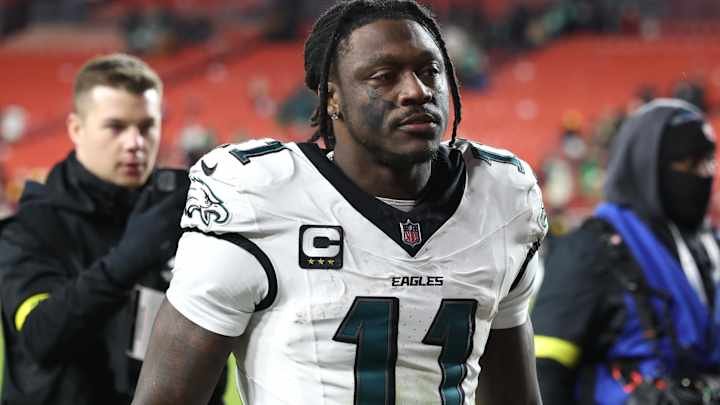
As the 2026 NFL draft draws near, the Linc is buzzing with a question that felt unthinkable just two seasons ago: Is it time to move on from AJ Brown?
The rumors aren’t just smoke anymore; they’re a full-blown forest fire. With reports of locker room unrest and a contract that is beginning to balloon, GM Howie Roseman is reportedly weighing a “Quinnen Williams-type” haul—a first-rounder and a “sweetener”—for the All-Pro wideout. Before we either book his flight to New England or chain him to the gates of South Philly, let’s look at the cold, hard reality of both sides.
The Positives: Why the Eagles Should Pull the Trigger
1. Maximizing Trade Value While It’s Peak
AJ Brown is 28. In “receiver years,” he’s entering the back nine of his prime. Right now, he is still a verified WR1 who can command a first-round pick (potentially No. 31 from the Patriots) and change. If the Eagles wait another year and his production dips or the “unrest” goes public, that value vanishes.
2. Salary Cap Flexibility
Brown’s cap hit for 2026 is roughly $23.4 million, and it only goes up from there. By moving him—especially after June 1—the Eagles could save significant cash to address “gaping holes” in the pass rush and the offensive line. With Lane Johnson pondering retirement and the edge rush unit thinning out, that money could be the difference between a rebuild and a reload.
3. Resetting the Culture
We’ve all seen the sideline pouting. While winning masks a lot of “diva” behavior, a stagnant offense (which ranked 19th in points last season) can’t afford distractions. If the relationship with Jalen Hurts has soured as whispered, moving Brown allows DeVonta Smith to ascend to the clear No. 1 role and lets the locker room breathe.
The Negatives: Why Trading Him is a Massive Risk
1. Who Replaces 1,000 Yards and 7 TDs?
You don’t just “replace” AJ Brown. While the Eagles signed Hollywood Brown this offseason, he is a vertical threat, not a physical alpha. Trading AJ leaves a massive void in the intermediate passing game. Relying on a rookie like Indiana’s Omar Cooper Jr. to fill those shoes in a “win-now” window is a terrifying gamble for Nick Sirianni.
2. The Dead Money Nightmare
The financial side isn’t all sunshine. Trading Brown before June 1 would result in a staggering dead cap hit of over $40 million. Even a post-June 1 trade leaves $16.3 million in dead money on the books. That is a lot of “ghost money” for a player catching touchdowns for another team.
3. Closing the Super Bowl Window
The Eagles are coming off an 11-6 season where they proved they can still compete at the highest level. Jalen Hurts is at his best when he has a receiver who can win 50/50 balls. If you take away his safety blanket, you risk regressing your franchise quarterback’s development and wasting a year of a championship-caliber roster.
The Verdict
Howie Roseman is the king of the “aggressive reset,” but trading AJ Brown would be his most polarizing move since trading Carson Wentz. If a team like the Patriots or Chargers offers a top-20 pick and a Day 2 selection, the logic of “addition by subtraction” becomes hard to ignore.
However, unless there is a concrete plan to snag an elite replacement in the draft, trading a Hall-of-Fame talent in his prime usually leads to one place: regret.
Written by Carey Iona (The Flyin Hawaiian)